

AMNYE MACHEN
THE MOUNTAIN · THE SPIRIT · THE NAME
The Mountain Behind the Name
In the remote north-eastern part of the Tibetan Plateau, the vast massif of Amnye Machen (Chinese: 阿尼玛卿; Tibetan: ཨ་མྱེས་རྨ་ཆེན།) rises above the grasslands of Amdo. Its principal summit reaches 6,282 metres, making it the highest peak in the Amnye Machen range, which forms part of the eastern Kunlun Mountains.
It is one of Tibet’s most sacred mountains, a major pilgrimage destination, and a place with a mythology so dense and layered that geography almost feels secondary to story. For centuries, Amnye Machen has been a centre of pilgrimage, mythology and spiritual significance. To the people of Golok, it is more than a geographical feature: the mountain is understood as a living presence, an ancestor, protector and guardian of the land.
I first saw Amnye Machen in 2005, and it has been the inspiration behind the name AMNIMAKEN ever since.
The Name
The Tibetan name is written ཨ་མྱེས་རྨ་ཆེན། and transliterated as A myes rMa chen. It appears in English in several forms, including Amnye Machen, Amne Machin and Amne Machen.
In Amdo Tibetan, the name can be approached through three elements:
Amnye (ཨ་མྱེས།) — a respectful and affectionate term meaning “grandfather” or “ancestral elder”.
Ma (རྨ།) — the traditional Tibetan name associated with the Yellow River, known in full as Machu (རྨ་ཆུ་). The mountain rises within the upper Yellow River region and is closely connected with the river in both geography and mythology.
Chen (ཆེན།) — “great”.
Taken together, these elements carry the sense of The Great Grandfather of the Ma River — or, more freely, The Great Ancestral Presence of the Yellow River. This is best understood as a cultural interpretation rather than a rigid word-for-word translation.
The name AMNIMAKEN was chosen to reflect this relationship. A mountain is not only a sacred summit to be revered from a distance. It is part of a living bond between people, place and those who came before them — a connection through which the presence of ancestors and the experience accumulated over generations continue to shape how people understand the landscape and their place within it.
The Mountain Deity
The mountain is closely associated with Machen Pomra, an ancient territorial deity whose history predates the arrival of Buddhism in Tibet.
He is traditionally depicted as a warrior wearing armour and riding either a white horse or a white snow lion with a turquoise-green mane. He carries weapons, banners and symbols of prosperity and is surrounded by an extensive retinue, often described as 360 divine companions.
For the nomadic communities of Amdo, Machen Pomra has long been a protector of people, animals and territory. Prayers addressed to him ask for the health and fertility of livestock, the return of lost prosperity, protection from enemies and misfortune, and the strengthening of lungta — the “windhorse” associated with vitality, confidence and good fortune.
Different traditions describe him as a mountain god, ancestral deity, warrior, guardian of treasures or protector of Buddhist teachings. These identities developed over many centuries and were never reduced to a single fixed story.
The Palace That Became a Mountain
One regional legend tells of a celestial ruler who sent his eight sons to govern different parts of the world. The fourth son travelled to Amdo, crossing ninety-nine mountains, ninety-nine rivers and ninety-nine plains.
Along the way, he defeated harmful spirits, wild animals and violent men. He taught courage, compassion and respect, eventually becoming the protector of the region.
His father later arrived with an army of 1,500 horsemen and built a nine-storey palace of white jade for his son. Its walls were made of crystal, its roof of gold and silver, and its highest ridge of coral.
Thunder sounded and clouds surrounded the palace. When they cleared, the building had become the snow-covered mountain of Amnye Machen.
According to the same tradition, the gods of the surrounding mountains return here to gather during every Year of the Horse.
An Ancient Deity in a Buddhist World
Early Bön ritual traditions place Machen Pomra among the powerful spirits known as nyen. Fragmentary texts connect him with a group of eight divine brothers and with ancient ceremonies of purification. These accounts preserve a world in which mountains, clans, animals and territorial spirits were bound together through kinship and ritual obligation.
Later Buddhist legends describe how Padmasambhava summoned and subdued Machen Pomra, binding him by an oath to protect the Dharma. The deity did not disappear. Instead, he entered the Buddhist world while retaining much of his older identity as a proud and independent warrior.
Some later traditions elevated him further, describing him as a bodhisattva or associating the mountain with Avalokiteshvara. Amnye Machen therefore represents several layers of Tibetan history at once: ancestral belief, Bön ritual, Buddhist transformation and continuing local practice.
Amnye Machen and King Gesar
The mountain occupies an important place in the Epic of King Gesar, one of the great living epic traditions of Central Asia.
In some versions, Machen Pomra is the celestial father of Gesar. In others, he is the hero’s protector, military ally or spiritual support. The mountain is sometimes described as the place where Gesar’s life force or protective spirit resides.
The surrounding landscape is filled with places connected to the epic. Pilgrims identify the throne of Gesar, the tracks of his horse, places associated with his wife Sengjam Drukmo, and rocks said to contain the imprints or possessions of other heroes. Weapons, whips and sacred objects are believed to remain hidden within the mountain until they are needed again.
These stories continue to evolve. New places are recognised, old landmarks receive new interpretations, and the epic remains part of the living geography of Amnye Machen.
The Pilgrimage
Pilgrims travel around the entire massif on a ritual circuit known as a kora. The journey passes glaciers, high valleys, lakes, river crossings and places associated with deities, Buddhist masters and epic heroes.
The mountain is understood as both a divine palace and a vast natural mandala. Traditional pilgrimage guides describe meditation caves, healing springs, hidden scriptures, sacred letters formed in the rock and places inhabited by nāgas and other non-human beings.
At one glacier, pilgrims touch or taste the ice and collect water believed to carry healing and protective qualities. Elsewhere, rocks known as the Scales and Mirror of Yama are said to reveal the balance of a person’s good and harmful actions. Passing through a difficult section called the Road to Hell is believed to purify negative karma before death.
The pilgrimage is considered especially powerful during the Year of the Horse, when territorial deities are said to gather at the mountain. Thousands of people may arrive to complete the circuit, make offerings and renew their connection with the landscape.
Higher Than Everest
For much of the twentieth century, Amnye Machen carried another kind of legend. With the region remote and no reliable survey, explorers, pilots and newspapers published extraordinary estimates of its height. In 1949 the American explorer Leonard Clark returned from the Golok country claiming that the main summit stood at 29,661 feet — about 9,040 metres, higher than Everest. For a while, Amnye Machen was known in the West as a hidden giant, perhaps the highest mountain on Earth.
Modern surveys put its highest peak at 6,282 metres. The legend was wrong, but it captured the isolation of the massif and the impression it left on everyone who saw it from afar.
Why AMNIMAKEN
Amnye Machen brings together several ideas that are central to this project: mountains as living environments, movement through wild landscapes, respect for forces larger than ourselves, and the relationship between outer exploration and the mind.
The name is not intended as a claim of religious authority or as a representation of Tibetan tradition. It is an acknowledgement of a mountain whose meaning extends beyond altitude and achievement.
AMNIMAKEN approaches mountains and oceans not simply as places to conquer, but as spaces in which movement, attention and awareness can meet.
A journey may begin with a line through snow, a wave or a mountain trail. Yet what it can give us is almost impossible to measure. Often it is like a seed, quietly taking root and, sometimes much later, opening into something beautiful in our lives.
SOURCES & FURTHER READING
The history, geography and religious traditions associated with Amnye Machen draw on a wide range of Tibetan, academic and expedition sources. The following works provide useful background for the material presented on this page.
- Buffetrille, Katia. “The Great Pilgrimage of A-myes rMa-chen: Written Traditions, Living Realities.” In Mandala and Landscape, edited by Alexander W. Macdonald. D.K. Printworld, 1997.
- Karmay, Samten G. “Mountain Cults and National Identity in Tibet.” In Resistance and Reform in Tibet, edited by Robert Barnett and Shirin Akiner. Hurst, 1994.
- Berounský, Daniel. “An Old Tibetan Myth on Retribution for Killing the Nyen.” In Bon and Naxi Manuscripts, edited by Agnieszka Helman-Ważny and Charles Ramble. De Gruyter, 2023.
- Rock, Joseph F.The Amnye Ma-Chhen Range and Adjacent Regions: A Monographic Study. Istituto Italiano per il Medio ed Estremo Oriente, 1956.
- Clark, Leonard.The Marching Wind. Funk & Wagnalls, 1954.
- Rowell, Galen. “On and Around Anyemaqen.” American Alpine Journal, 1982.
These sources represent different perspectives, from Tibetan religious traditions and ethnographic research to early Western exploration and modern mountaineering history. Spellings and interpretations of names, deities and historical events vary between sources and traditions.
AN EXPEDITION IN THE MAKING
Ski Touring Around Amnye Machen
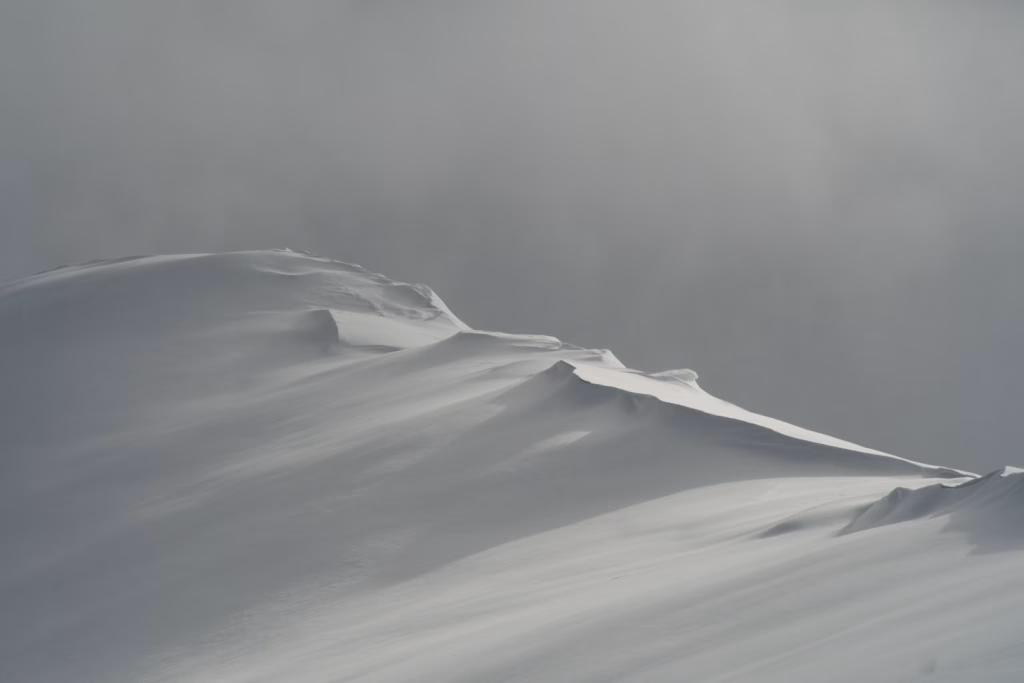
One day I would like to ski tour around Amnye Machen, a journey I have been preparing for many years. If you are an experienced backcountry skier or splitboarder with a genuine background in Buddhism, and this idea resonates with you, I would be glad to talk. I am looking for no more than three companions.
MORE AT AMNIMAKEN
LINES
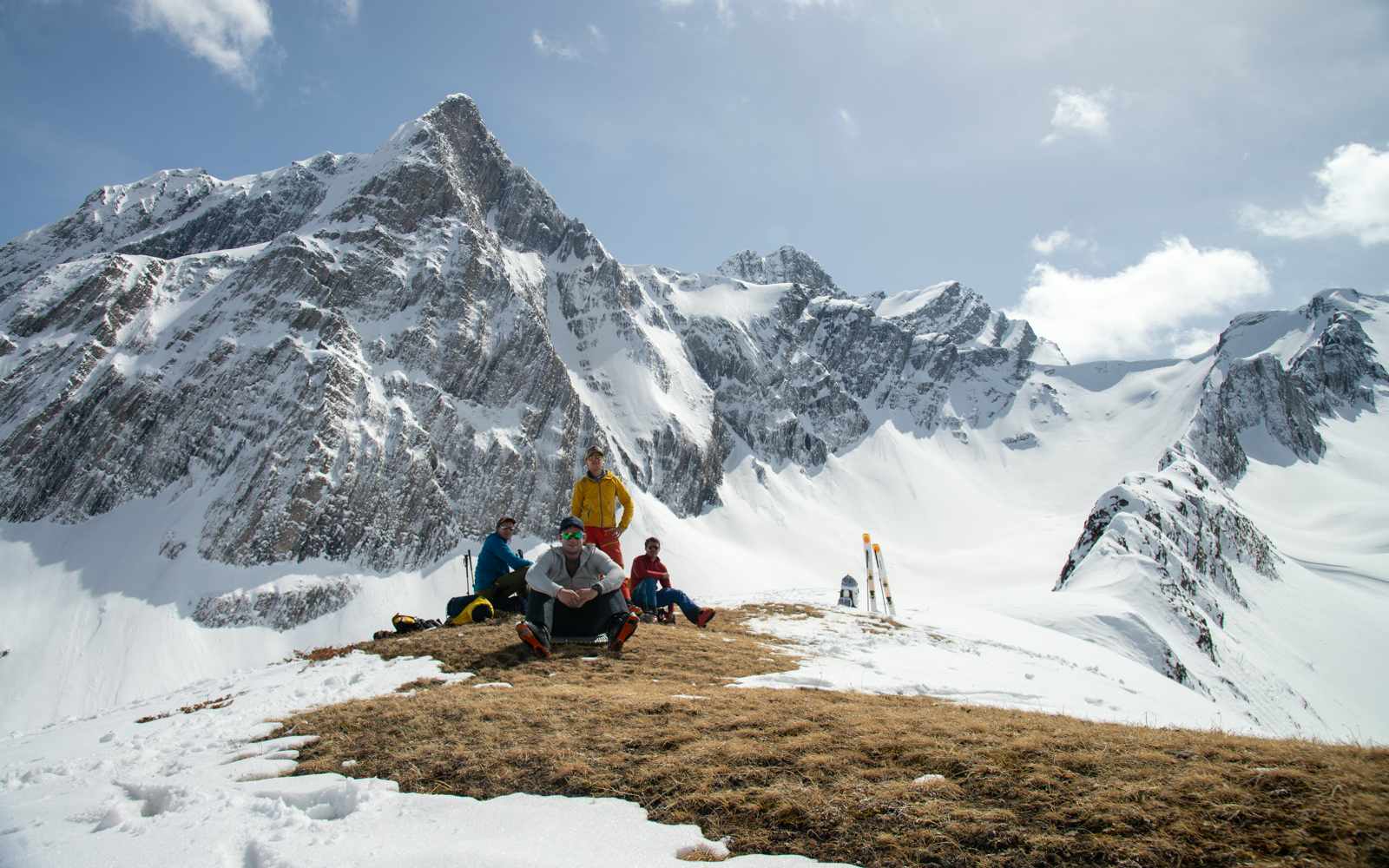
Ski touring sometimes combined with meditation. Open yourself to the mountains and let their scale put everything else into perspective.
WIND
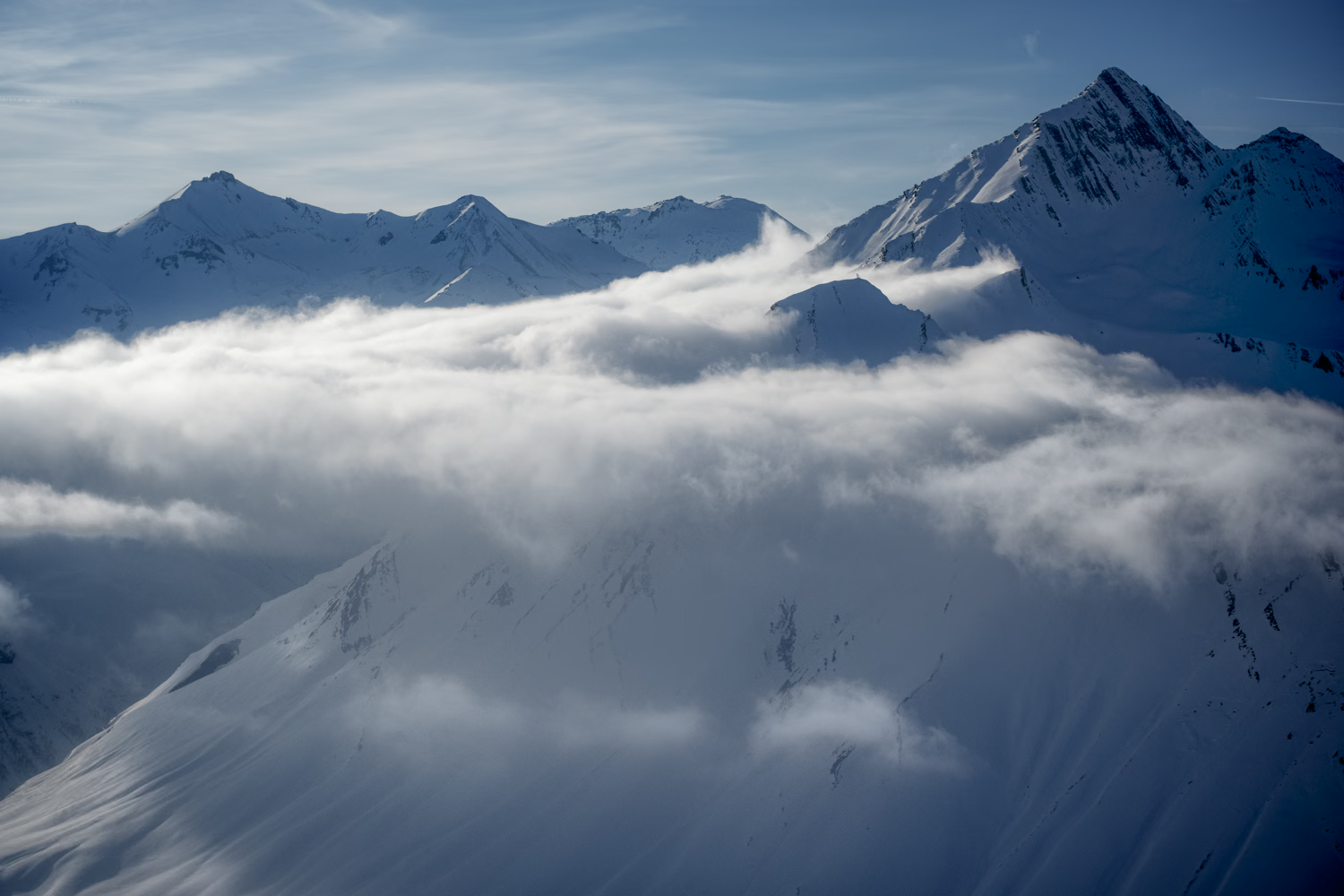
Body, breath, movement and energy in everyday life and physical activity. Tsa Lung courses and retreats offer a formal way to explore this dimension.

MIND
Meditation in ordinary life and outdoor activity, cultivating a more direct perception of reality and a greater sense of clarity, ease and connection.

WAVES
Surfing, freediving and breath practice. Let the ocean hold you for a while, and learn to move with the water, its rhythm and the space around you.